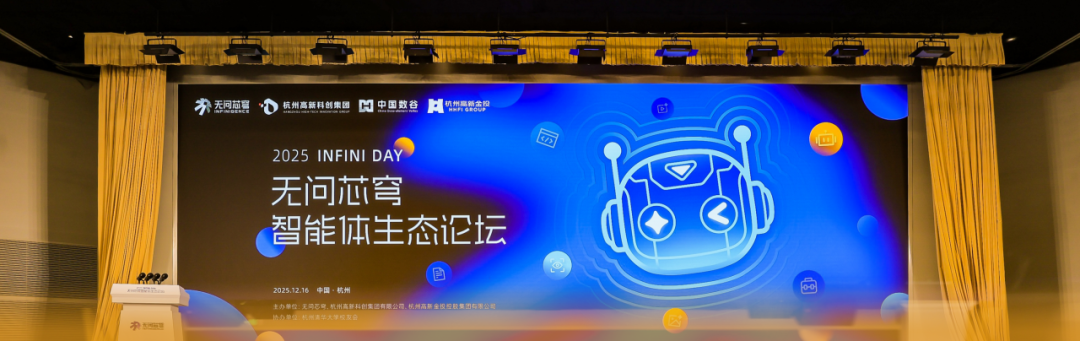
On December 16, 2025, the 2025 INFINI DAY Infinigence Agent Ecosystem Forum, hosted by Infinigence, was successfully held in Hangzhou. Co-organized with Hangzhou High-Tech Innovation Group and Hangzhou High-Tech Jintou Holding Group, the forum brought together leading experts, academics, and industry pioneers to explore the future of agent-driven innovation and ecosystem development. The event was attended by Zheng Di, Secretary of the Party Committee of Hangzhou High-Tech Zone (Binjiang). Keynote speeches and presentations were delivered by distinguished guests, including Wang Yu, Professor and Chair of the Department of Electronic Engineering at Tsinghua University and Founder of Infinigence; Yang Linxiang, Vice President of the Hangzhou Tsinghua Alumni Association; and He Shuibing, Tenured Professor at Zhejiang University. The forum also convened more than a dozen leaders from pioneering AI companies, who shared their latest industry insights, technological advances, and real-world deployment experiences. Through in-depth discussions on innovation, collaboration, and commercialization, participants explored how AI agents are evolving from technological breakthroughs into scalable, real-world applications. The event further strengthened industry collaboration and generated new momentum for building a thriving and sustainable agent ecosystem.
01
Academia and Industry Join Forces to Shape the Future of AI Agents
In his opening remarks, Wang Yu—Professor and Chair of the Department of Electronic Engineering at Tsinghua University, recipient of the National Science Fund for Distinguished Young Scholars, IEEE Fellow, and Founder of Infinigence—outlined three strategic priorities for the company's development in Binjiang. First, Infinigence aims to serve as a key connector within the AI ecosystem, enabling innovators to access the computing resources and services they need more efficiently and cost-effectively. Second, the company will act as an enabler of next-generation productive forces by advancing chip-model co-optimization and partnering with local enterprises to build benchmark cases for integrated hardware-software collaboration innovation. Third, Infinigence seeks to pioneer the future of AI agents by exploring high-impact application scenarios, including intelligent manufacturing and AI for Science, and by developing scalable models for agent adoption that can empower industries across Hangzhou, Binjiang, and beyond.

Address by Wang Yu, Professor and Chair of the Department of Electronic Engineering, Tsinghua University
In his remarks, Yang Linxiang, Vice President of the Hangzhou Tsinghua Alumni Association, expressed his hope that Infinigence, founded by Tsinghua alumni, will play a pivotal role in bringing together stakeholders across the AI agent value chain. He noted that the forum convened participants from across the agent ecosystem, creating an important platform for industry collaboration and coordinated development. Highlighting Hangzhou's dynamic innovation environment, strong economic vitality, and high quality of life, Yang also encouraged more Tsinghua alumni to pursue innovation and entrepreneurship in the city.
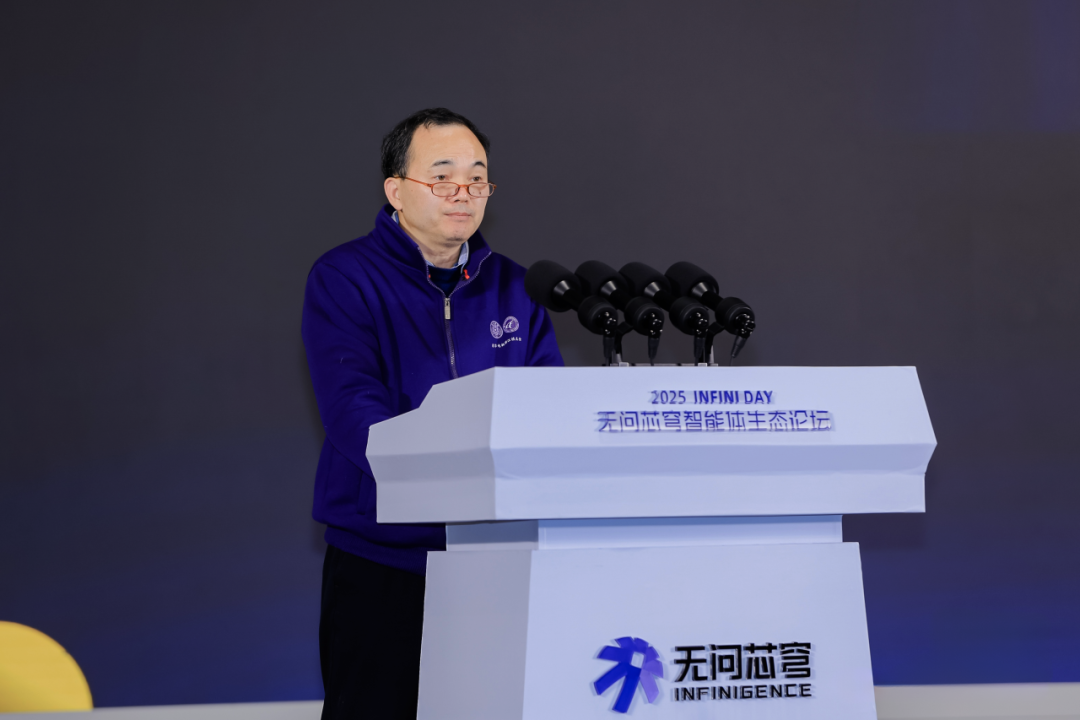
Address by Yang Linxiang, Vice President of the Hangzhou Tsinghua Alumni Association
He Shuibing, Tenured Professor at Zhejiang University, delivered an invited talk titled “AI Compute Clusters: Trends, Challenges, and Practices.” He noted that robust compute infrastructure has become a critical foundation for AI competitiveness. With the computing requirements for training state-of-the-art foundation models growing by approximately 360% annually, demand for large-scale AI compute clusters continues to surge. To address this challenge, he highlighted the importance of creating a virtuous cycle among model development, computing hardware, and software frameworks—where evolving model requirements drive hardware innovation, advances in hardware capabilities enable software optimization, and software breakthroughs further accelerate model evolution. Addressing key challenges in next-generation AI infrastructure, including scalability, heterogeneous compute and networking architectures, and system efficiency, He shared a range of innovative practices, such as GPU memory management techniques for large-model training and importance-aware, multi-tier KV cache architectures for inference workloads. He emphasized that the advancement of AI computing is not solely a technological challenge, but a broader competition encompassing technology, ecosystems, and applications. Building an open, unified, and collaborative ecosystem, he noted, will be essential to unlocking the full potential of intelligent computing.

He Shuibing, Tenured Professor at Zhejiang University, delivered an invited talk
02
From Creativity to Productivity: The Infinigence Agent Service Platform Empowers Enterprises to Scale AI Agents into Production From Innovation to Impact: Helping Enterprises Scale AI Agents into Production
At the forum, Infinigence officially unveiled its Infinigence Agent Service Platform. While robust and reliable infrastructure provides the foundation for AI agent innovation, many organizations still face significant challenges in moving from experimentation to large-scale production deployment. These challenges include achieving production-grade performance, ensuring operational reliability, managing infrastructure and operational costs, and translating technological capabilities into sustainable business value.
The Infinigence Agent Service Platform empowers enterprises to take the critical step from experimentation to production, enabling reliable and scalable deployment of AI agents across the organization.

The Infinigence Agent Service Platform was officially unveiled
“We believe that in the future, every enterprise will be agentic,” said Xia Lixue, Co-founder and CEO of Infinigence. “As organizations deploy 10, 100, or even 1,000 AI agents across their workflows, their capacity for creation and execution will be dramatically amplified.Even the smallest teams will be able to deliver outsized impact.”

Co-founder and CEO of Infinigence
For enterprise users, the Infinigence Agent Service Platform provides ready-to-use agent capability templates and stable, reliable hosting services. It supports a wide range of scaffolding tools and is deeply integrated with Infinigence’s underlying compute and model infrastructure. Built on a next-generation Agentic Infrastructure stack, the platform delivers end-to-end support across the entire lifecycle of enterprise AI agents — from customization and optimization, to deployment, hosting, and commercialization. This enables organizations to achieve higher-quality agent performance, more stable large-scale operations, improved cost efficiency, and smoother paths to business value realization, ensuring reliable and scalable agent adoption in production environments.
Xia Lixue stated: “Looking ahead, Infinigence will further deepen its integration with Hangzhou’s rich application scenarios, focusing on strategic development in the agent space. Leveraging the strong AI ecosystem and innovation advantages of Binjiang District, we aim to accelerate the integration of agent technologies across diverse real-world use cases. We will also work closely with partners across the value chain to build a collaborative ecosystem and contribute to the continued advancement of the regional AI industry.”
03
From Lab to Industry Chain: Industry, Academia, and Research Join Forces to Build a Thriving Agent Ecosystem
The rapid growth of the AI agent ecosystem relies on close coordination between ecosystem partners and continuous technological innovation. At the forum, a series of major partnership agreements were signed, spanning the full industry–academia–research value chain — from joint R&D and industrial incubation to data security and compliance. These collaborations bring together capabilities across sectors, creating strong momentum for advancing the agent ecosystem and accelerating the adoption of AI agents across industries.
Collaboration across the industry chain will lay a solid foundation for the long-term development of the agent ecosystem.Hangzhou High-Tech Innovation Group and Hangzhou Infinigence announced a strategic partnership at the forum.Going forward, as a leader in agent infrastructure, Infinigence will leverage its core technological strengths and platform achievements in AI compute, model platforms, and agent services, and deeply integrate them with Hangzhou High-Tech Innovation Group’s platform advantages in industrial resources and innovation services. Together, the two parties aim to accelerate the transformation of technological innovation into real-world applications, advance the development of the AI agent ecosystem, and build a regional hub for AI-driven innovation and industry collaboration with strong demonstrative impact.
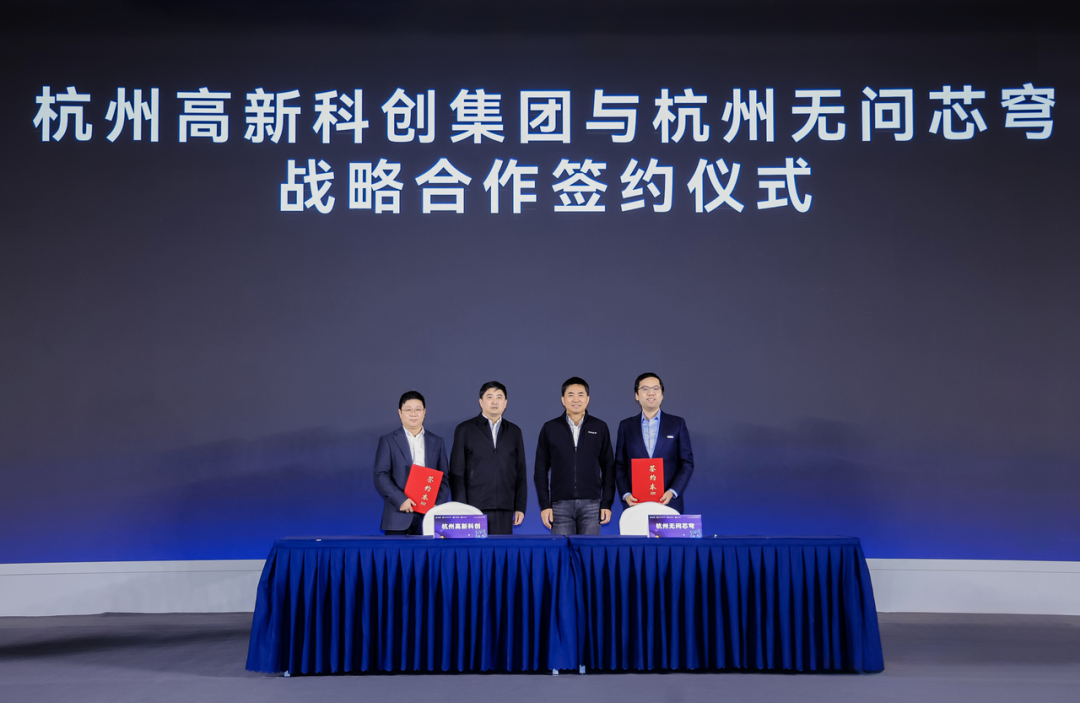
Tian Shujun, Chairman of Hangzhou High-Tech Innovation Group, and Xia Lixue, Co-founder and CEO of Infinigence, signed a strategic cooperation agreement on behalf of both parties. Zheng Di, Secretary of the Party Committee of Hangzhou High-Tech Zone (Binjiang), and Wang Yu, Professor and Chair of the Department of Electronic Engineering, Tsinghua University, witnessed the signing.
Deep integration of industry, academia, and research serves as a key driver of innovation and technology transfer. During the forum, the Hangzhou Innovation Institute of Beihang University and Hangzhou Infinigence held a signing ceremony to jointly establish an AI Agent Joint Laboratory. The two parties will collaborate on exploring technological breakthroughs and pathways to industrialization in AI agents, aiming to accelerate the transformation of AI capabilities into real-world productivity through sustained innovation and systematic R&D support.

Wang Jun, Dean of the Hangzhou Innovation Institute of Beihang University, and Li Boxun, Chief Technology Officer of Infinigence, signed a cooperation agreement on behalf of both parties. Dong Zhuoning, Assistant to the President of Beihang University, Deputy Party Secretary and Dean of the Hangzhou Innovation Institute, and Director of the Beihang University (Hangzhou) Management Committee Office, and Xia Lixue, Co-founder and CEO of Infinigence, witnessed the signing
Trusted and secure data circulation is a critical enabler for the deep integration of AI agents with real-world industry needs and a key prerequisite for large-scale deployment. At the forum, Hangzhou Hi-Tech Digital Commerce Technology Group Co., Ltd. and Infinigence announced a strategic collaboration on the “Three Data, One Chain+ Agent” initiative. The two parties will combine their respective strengths in trusted data circulation infrastructure and scalable AI agent production capabilities to jointly build secure and efficient data-to-intelligence transformation pathways for the agent era. This collaboration aims to strengthen the foundational infrastructure for secure data exchange and accelerate the high-quality deployment of AI agent technologies across a wide range of industries.

Zhou Shangchen, Deputy General Manager of Hangzhou High-Tech Innovation Group, and Li Boxun, Chief Technology Officer of Infinigence, signed the cooperation agreement on behalf of both parties
Information security is the primary prerequisite for the sustainable operation of AI agents and their expansion into global markets.Leveraging Colorlight’s deep expertise in information security and intelligent hardware R&D, together with Infinigence’s capabilities in AI infrastructure and agent systems, the two parties will jointly develop integrated “Information Security+” agent solutions and accelerate their deployment across global markets. The collaboration aims to establish a trusted and resilient security foundation for next-generation intelligent applications worldwide.

Zhou Jinzhi, Chairman and CEO of Colorlight Cloud Tech Ltd, and Dai Guohao, Associate Professor at Shanghai Jiao Tong University and Co-founder and Chief Scientist of Infinigence, signed the cooperation agreement on behalf of both parties
04
From Scenarios to Value: Accelerating the Emergence of “Agent+” Breakthrough Applications
AI agents are expanding across industries with unprecedented breadth and depth, reshaping production processes, innovation paradigms, and even underlying business models. At the forum, practitioners from a range of industries shared their firsthand experiences and insights on the ongoing “Agent+” transformation, offering valuable perspectives and directional guidance for the evolution of the sector.
In the automotive industry, amid the accelerating wave of intelligent transformation, AI agents are being deeply integrated across the entire value chain, from R&D and manufacturing to customer-facing services. Yao Binhui, Chief Digital Officer of Geely Holding Group, shared Geely’s approach to leveraging AI to advance high-quality development in China’s automotive sector. The company is systematically driving AI integration across three layers: product intelligence, enterprise intelligence, and industry intelligence.
Based on 10,000-GPU-scale compute, Geely is driving AI-powered upgrades in powertrains, chassis, cockpits, and driver assistance systems. Through super agents, Geely is embedding AI capabilities into marketing, R&D, HR, and other scenarios to drive management transformation. Built on compute infrastructure at the 10,000-GPU scale, Geely is enabling AI-driven upgrades across powertrain systems, chassis, smart cockpit, and advanced driver assistance technologies. Through “super agents,” the company is further embedding AI capabilities into marketing, R&D, human resources, and other enterprise functions, accelerating organizational transformation.
Geely is also distilling its own practices into industry solutions, providing practical reference models for the automotive industry’s transition from “digital-native” to “AI-Native.”

Yao Binhui, Chief Digital Officer of Geely Holding Group
In an increasingly competitive landscape dominated by large players, identifying a precise and differentiated strategy has become a key survival rule for innovative startups seeking to break through. Zhao Chong, Founder and CEO of PixelBloom, used AiPPT.com—a globally popular AI office productivity product with tens of millions of users—as a case study to share the company’s strategic focus: concentrating on a single product to become a global category leader. He described PixelBloom’s product philosophy as “going 100 meters deep in a one-centimeter-wide space,” emphasizing extreme focus and continuous refinement to achieve product excellence through concentrated effort. Zhao noted that AI startups should avoid over-indexing on building full-stack “platform dreams.” Instead, they should embrace their position within the broader ecosystem, actively identifying their niche and transforming potential competitive dynamics into symbiotic, win-win collaborations. In doing so, startups can achieve rapid, sustainable growth within highly specialized segments.

Zhao Chong, Founder & CEO of PixelBloom
The rapid rise of high-quality AI-generated content is inseparable from the continuous evolution of underlying infrastructure. Yang Kejia, Co-founder of LiblibAI, shared the company’s journey from China’s largest AI image and video community and generation platform to a vertical agent platform focused on the design industry. He noted that this evolution in AI creative experiences has been accompanied by a fundamental shift in infrastructure requirements—from a primary focus on improving inference efficiency to a broader need to support long-context task management, reinforcement learning training frameworks, multimodal workloads, and intelligent resource scheduling. Looking ahead, Yang emphasized that agent infrastructure must evolve from model-centric compute scheduling to capability-oriented orchestration. In this paradigm, compute resources are dynamically allocated based on application scenarios, workload types, and time-sensitive demand, enabling significantly higher overall resource efficiency.

Yang Kejia, Co-founder of LiblibAI
Compared to general-purpose agents, specialized agents designed for vertical scenarios offer more precise task alignment and higher value density. Teng Hansi, Founding Member and Head of Commercialization at Sand.ai, articulated a clear strategic trade-off: “chasing versatility often leads to mediocre performance across the board.” Based on this principle, Sand.ai has focused its efforts on building “top-tier AI actors,” concentrating resources on core capabilities such as high-precision lip-sync, expressive character performance, preservation of original voice characteristics, and multilingual support.
Teng emphasized that the success of specialized agents lies in pushing core strengths to the extreme while relying on ecosystem partners to compensate for limitations. By doing so, companies can build defensible competitive advantages in highly specialized domains and establish a differentiated path for AI agent innovation.
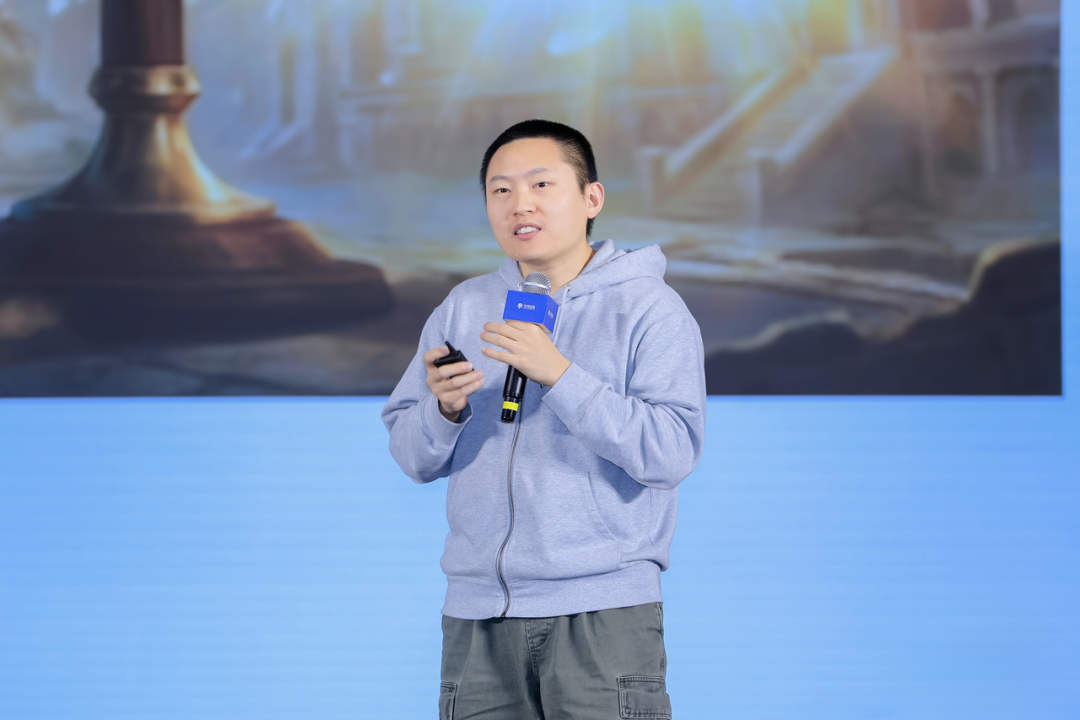
Teng Hansi, founding member and Head of Commercialization at Sand.ai,
This forum served as a platform for in-depth dialogue and the exchange of ideas between Infinigence and its industry ecosystem partners in the era of Agentic AI. It clearly outlined an emerging AI development paradigm—one driven by AI agent applications, built upon robust infrastructure services, and strengthened through deep ecosystem collaboration. Across discussions ranging from the evolution of infrastructure to agent platform capabilities, and from industry–academia–research collaboration to end-to-end value chain partnerships, Infinigence reaffirmed its commitment to an open and mutually beneficial ecosystem approach. Together with its partners, the company continues to advance a tightly integrated “industry chain + innovation chain” framework for agent innovation. This approach aims to make AI agents a true force multiplier for creativity and productivity, enabling scalable impact across industries.