Recently, at the QCon Global Software Development Conference, Xia Lixue, co-founder and CEO of Infinigence, delivered a keynote titled “Agentic Infra: Reinventing Infrastructure for the Age of AI Agents.” In his talk, Xia noted that AI is rapidly advancing toward higher levels of intelligence and autonomy, ushering in an era of multi-agent systems capable of independent decision-making and action. However, today's infrastructure is increasingly struggling to meet the demands of this new generation of AI systems, highlighting the urgent need for a fundamentally new infrastructure stack designed specifically for the agent ecosystem.
To address this challenge, Xia outlined a two-stage roadmap: "From Agent Infra to Agentic Infra." The vision is to help AI agents evolve from experimental demonstrations into real-world productivity tools, and ultimately enable large-scale deployment across industries. "As we move from viewing agents as tools to embracing them as collaborators," Xia noted, "Agentic Infra will provide the foundation needed for the next generation of AI to evolve, scale, and create real-world impact. This is not merely a technological upgrade—it is a systemic transformation that infrastructure must evolve to support."
01
A Growing Gap: Traditional AI Infrastructure Can No Longer Meet the Demands of the Agent Era
OpenAI has outlined a five-stage framework for the evolution of artificial intelligence from a technical perspective. Viewed through the lens of real-world adoption, a similar five-stage progression can be observed across the industry.
According to Xia, we are now at a pivotal moment—one defined by the continued advancement of Level 3 (Agentic AI) and the transition toward Level 4 (Innovative AI). So it is critical to focus on how intelligent agents are deployed, scaled, and continuously evolved in real-world environments.

While large language models (LLMs) continue to advance at a remarkable pace, AI agents built on top of them are still struggling to consistently deliver reliable results in production environments. Coding agents offer a clear example. Despite growing expectations that AI will be able to generate production-ready applications or services with a single prompt, the reality remains far more complex. A substantial gap still exists. Xia Lixue argued that using many of today's AI agents can feel like "opening a mystery box"—you never know exactly what you're going to get. "The issue is not that the underlying models lack intelligence," he said. "Rather, today's infrastructure was not designed for agents. It lacks the support agents need in areas such as execution environments, contextual awareness, tool integration, security, and observability."

Xia further explained that traditional AI infrastructure was built around a relatively straightforward objective: providing reliable compute resources and efficient task orchestration for discrete, well-defined workloads, with control logic explicitly programmed by developers. The agent era, however, introduces a fundamentally different set of requirements. Instead of supporting isolated tasks, infrastructure must enable persistent, interactive workflows in which agents continuously perceive, reason, make decisions, and take action. As a result, a greater share of operational decision-making is delegated to the agents themselves.
Key metrics extend beyond traditional measures such as task performance, resource utilization, and compute efficiency. In agentic systems, organizations must also evaluate the quality of agent decision-making, behavioral reliability, and overall system security.
02
Two Phases: From Agent Infra to Agentic Infra— Paving the Way for Scalable Adoption
To meet the evolving demands of both current and next-generation AI systems, Xia proposed a two-phase roadmap: from Agent Infra to Agentic Infra. The objective is to help AI agents progress from proof-of-concept demonstrations to production-grade capabilities, ultimately enabling large-scale adoption across real-world applications.

The first phase centers on building Agent Infra that can support the stable operation of agents in specific scenarios.
According to Xia, "Agent Infra enables the full potential of advanced models to be realized in practice, helping agents evolve from proof-of-concept demonstrations into tools that deliver real-world productivity."
Xia further highlighted the primary bottlenecks in today's agent development landscape. He argued that Agent Infra must be built around four core pillars: environment, context, tools, and security isolation. Strengthening these foundational capabilities is essential to improving agent reliability and establishing a solid base for future performance and scalability.
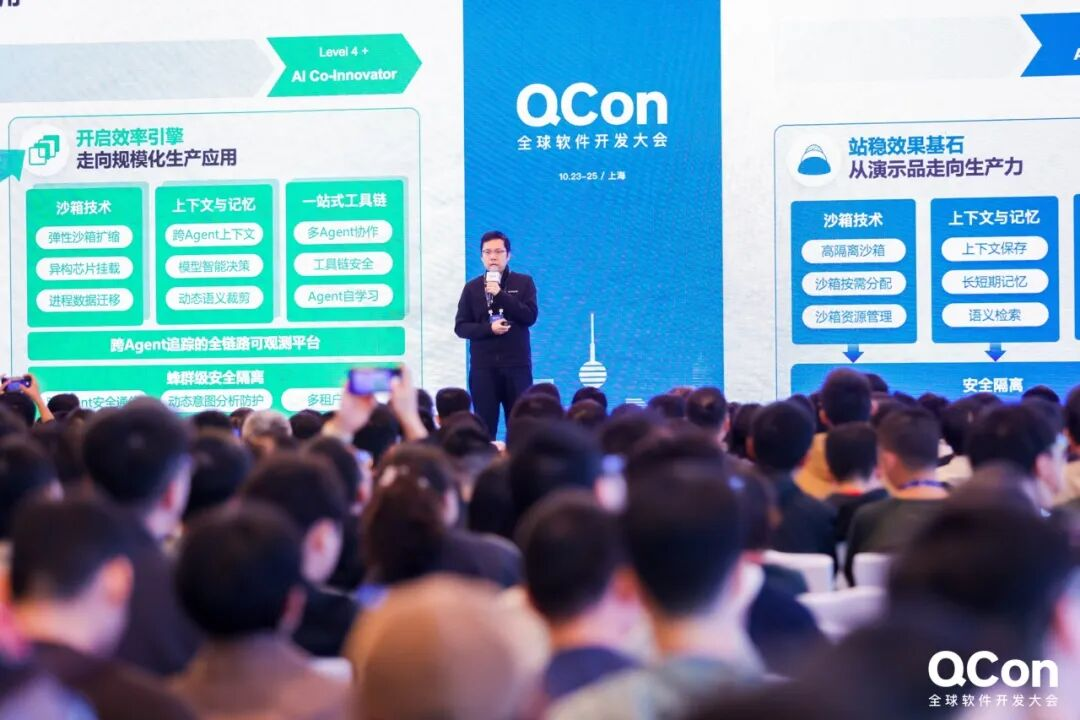
Looking ahead, even more advanced forms of intelligence are likely to emerge from the vast amount of experience agents accumulate through continuous interaction with the real world. A central challenge for the agent era, therefore, is how to create the conditions for AI systems to learn, iterate, and improve at scale—accelerating the deployment of cutting-edge technologies in real-world applications while generating the feedback loops that drive further advancement and broader societal value.
Production-scale environments bring an entirely new level of complexity. Organizations must contend with rapidly changing requirements, increasingly sophisticated optimization demands, and the operational challenges of running large-scale agent services. As multi-agent systems grow in size and capability, infrastructure must address rising coordination complexity, maintain service quality, and control the escalating costs of operations and management. Against this backdrop, Xia argued that the second phase is centered on building Agentic Infra—an infrastructure paradigm designed to support the continued evolution and large-scale deployment of next-generation AI systems.
According to Infinigence, this requires more than incremental improvements in execution environments, context, tool, security, and observability. The next step is to enable agents to participate directly in core infrastructure workflows and to establish a unified framework for multi-agent coordination, ensuring reliable and efficient collaboration across large numbers of agents. The ultimate vision is a new Agentic Infra paradigm in which agents can understand, coordinate with, supervise, and continuously improve one another. In this model, agents are no longer treated merely as tools, but as collaborators.
03
Building for the Next Era: Infinigence's Progress Toward Agentic Infra
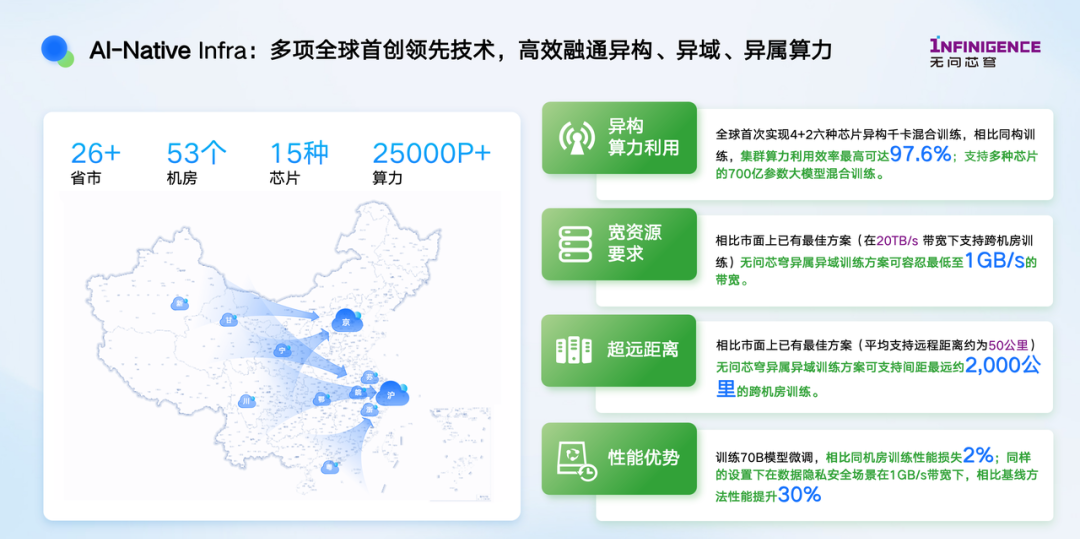
Over the past several years, Infinigence has established a strong foundation in AI-native infrastructure, building extensive expertise in large-scale compute deployment and platform operations. The company has deployed more than 25,000 PFLOPS of computing capacity across over 20 cities in China. At the same time, Infinigence has integrated reinforcement learning capabilities across the infrastructure stack—from execution environments and compute resources to AI frameworks—laying the groundwork for the next generation of agent-centric systems. These investments provide a critical foundation for expanding AI capabilities and accelerating the transition toward more advanced forms of intelligence.
In the agent era, Infinigence is leveraging its strong AI-native foundation to systematically upgrade four core pillars of its infrastructure: execution environments, context engineering, toolchains, and security isolation. Taking its sandbox system as an example, the company has built a three-layer architecture designed to support multiple sandbox configurations across diverse scenarios. While maintaining strict isolation guarantees, the system balances performance and flexibility, providing a stable and reliable runtime foundation for concurrent multi-agent workloads and heterogeneous tasks. The platform is also engineered for high throughput and millisecond-level scheduling latency, with full lifecycle management of sandbox instances. This enables a fully automated, traceable, and optimizable agent execution environment. As a result, every agent, tool invocation, and context execution runs within a secure, isolated, and fully controllable sandbox environment.

Moving into the Agentic Infra phase, Infinigence has been exploring deeper forms of agent collaboration by building an infrastructure-level agent swarm system. This system unifies what were traditionally fragmented workflows across development, operations, and business teams into a single intelligent platform, enabling compute resources to be delivered to end users in a far more automated and efficient way. With this end-to-end capability, the compute platform is no longer a passive resource provider. Instead, it can actively and autonomously support R&D workloads and business objectives, resulting in significant improvements in cluster resource utilization, energy efficiency, and overall system reliability.
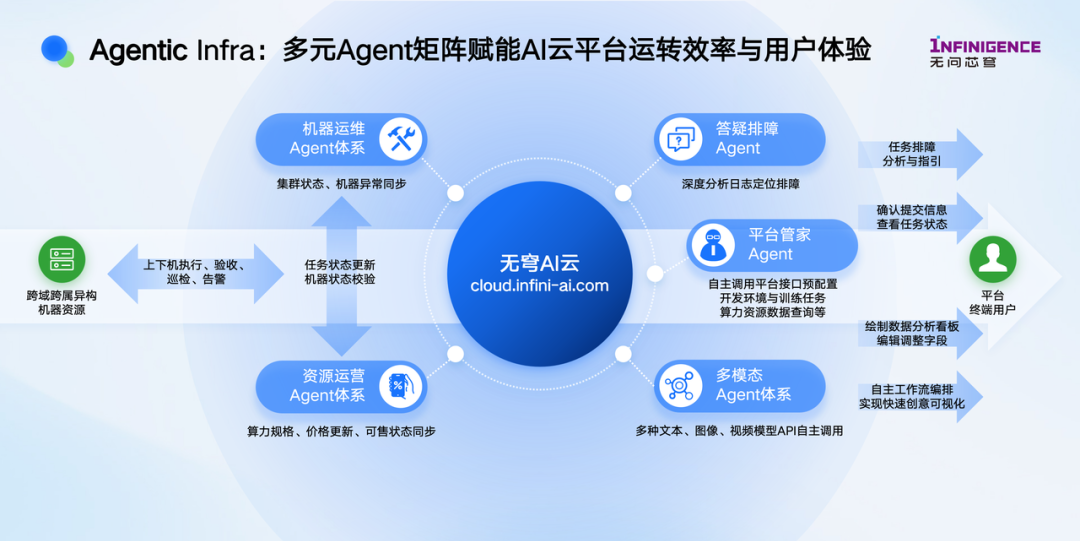
Xia Lixue further noted that today’s multi-agent systems face five fundamental challenges: communication silos, opaque decision-making, fragmented capabilities, inefficient orchestration, and limited observability. To address these issues, Infinigence has developed a comprehensive technology stack that includes a communication bus, an intelligent routing layer, a capability registry, a collaboration protocol layer, and a system-wide observability framework. Together, these components form an infrastructure-level agent swarm system designed to be inherently communicable, routable, and observable. Built on this foundation, and combined with the C2C (Cache-to-Cache) communication mechanism jointly developed with Tsinghua University, the system enables agents to better understand one another, coordinate automatically, and continuously improve through interaction. This provides a systematic approach to addressing the core challenges of multi-agent collaboration.
04
Outlook: A2A and the 80/20 Principle of Future Agentic Infrastructure
Finally, Xia Lixue introduced a bold long-term vision centered on A2A (Agent-to-Agent) collaboration. He suggested that future AI infrastructure may follow an 80/20 composition—where approximately 20% consists of traditional AI infrastructure, and 80% consists of agents. By enabling multi-agent collaboration across all layers of AI infrastructure, the system could ultimately reach a state of “agents producing agents,” driving the entire agent ecosystem toward self-evolution and continuous development.
Infinigence has consistently upheld its mission of “Infinity Computing, Accelerating the Future of AGI” and is committed to advancing inclusive AI through continuous technological innovation. Looking ahead, Xia Lixue expressed hope that Agentic Infra can truly support the deployment and long-term development of agents, create enduring value across a wide range of industrial applications, and ultimately evolve into a foundational force that benefits everyone.